
GURU guiding SHISHYA ln SPIRITUAL PATH


with horse face
GURU VISHNU,
GURU DEO MAHESHWARA,
GURU SAKSHATH PARABRAHMA,
TASMAI SHREE GURUVE NAMAHA..
SACHIDANADA ROOPAYA
BINDU NADANTHARATHMANE
ADIMADYANTHA SHOONYAYA
GURUNAM GURUVE NAMAHA
The word ‘Guru’ is derived from the Sanskrit language and
has a deep spiritual meaning. Its two syllables Gu and Ru
stand for the following --
Gu denotes the spiritual ignorance that most of humankind
is in.
Ru represents the radiance of spiritual knowledge that
Ru represents the radiance of spiritual knowledge that
dispels the spiritual ignorance.
In short, the Guru is the One who dispels the darkness of
spiritual experiences and spiritual knowledge.
Q: Who can be considered as a Guru (the spiritual teacher)?
A: That one who knows the truth, who lives in and as truth
and who always (satatam) strives for the good of his (hita)
disciple(s) (sishya).
However Nirvana Shathakam of Sri Shankaracharya-
Sloka 5 says ' I am neither GURU nor SHISHYA' indicates
a GURU who has reached perfection,with firm abidance as
ATHMA,JEEVANMUKTA cannot think himself as GURU &
hence he cannot give DIKSHA. From this highest level of
knowledge,a GURU who gives DIKSHA is seen as bound
by MAYA !
RAMAKRISHNA PARAMAHAMSA ON GURU ---
"Satchidananda alone is the Guru. If a man in the form
of a guru awakens spiritual consciousness in you, then
know for certain that it is God the Absolute who has
assumed that human form for your sake. The guru is like
a companion who leads you by the hand. After the
realization of God, one loses the distinction between the
guru and the disciple. 'That creates a very difficult
situation; there the guru and the disciple do not see each
other.' It was for this reason that Janaka said to Sukadeva,
'Give me first my teacher's fee if you want me to initiate
you into the Knowledge of Brahman.' For the distinction
between the teacher and the disciple ceases to exist after
the disciple attains to Brahman. The relationship between
them remains as long as the disciple does not see God."
However Nirvana Shathakam of Sri Shankaracharya-
Sloka 5 says ' I am neither GURU nor SHISHYA' indicates
a GURU who has reached perfection,with firm abidance as
ATHMA,JEEVANMUKTA cannot think himself as GURU &
hence he cannot give DIKSHA. From this highest level of
knowledge,a GURU who gives DIKSHA is seen as bound
by MAYA !
RAMAKRISHNA PARAMAHAMSA ON GURU ---
"Satchidananda alone is the Guru. If a man in the form
of a guru awakens spiritual consciousness in you, then
know for certain that it is God the Absolute who has
assumed that human form for your sake. The guru is like
a companion who leads you by the hand. After the
realization of God, one loses the distinction between the
guru and the disciple. 'That creates a very difficult
situation; there the guru and the disciple do not see each
other.' It was for this reason that Janaka said to Sukadeva,
'Give me first my teacher's fee if you want me to initiate
you into the Knowledge of Brahman.' For the distinction
between the teacher and the disciple ceases to exist after
the disciple attains to Brahman. The relationship between
them remains as long as the disciple does not see God."

MATHA,GURU,GODDESS MAHALAKSHMI


GURU AVADHUTHA SAKARAYAPATTANA
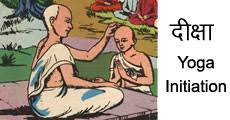
WHAT IS DIKSHA ?
divyam jnanam yato dadyat
kuryat papasya sankshayam |
tasmad dikseti sa prokta
tasmad dikseti sa prokta
desikais tattva-kovidaih ||
"The process that bestows divya jnanam (transcendental
spiritual knowledge) and destroys sin , is called 'Diksha' by
the spiritual persons who have seen the Truth (desikais
tattva-kovidaih)."
Through Mantra-Diksha, the Guru rekindles the dormant
powers of the aspirant. Diksha is composed of two
syllables, 'Diksha', 'Di' and 'ksha'. 'Di', means what is given
or the person capable of bestowing divine grace.And 'ksha'
means one who is capable of assimilating. On one side is
the benediction of the one (The Guru) who is capable of
imparting the Lord's grace and on the other hand is the
assimilating capability of the aspirant. The combination of
these two is Diksha.
i.e. The act, by which teachings are given and by which all
kinds of animal instincts are demolished, which is granted
by Gurudev in charity is known as Diksha.
Diksha is a unique and rare process of making the life of a
disciple more pure, more enlightened and more successful.
Generally a human being remains under the sway of bad
karmas of past lives which do not allow him to make the
desired level of progress in spite of hard work and sincere
efforts.



SOME GURUS DO NOT GIVE DIKSHA, WHY ?
A real SELF- REALISED GURU is a JEEVANMUKTA, who
sees GOD(ATHMA) in all. With this thinking he cannot give
DIKSHA, as he cannot think somebody else as SHISHYA
which creates duality or dvaitha. Another reason is that world
what you see is only a mental projection like dream, it is not
real, then where is the question of DIKSHA giving !
A sadhak who is the follower of above guru can think him as
his GURU, but without taking DIKSHA ! Such sadhaks also
make spiritual progress !
RAMANA MAHARSHI is a good example for this type of
GURU. KRIPALUGI MAHARAJ living saint at VRANDAVAN
is another example.You see hundreds of shishyas in TV
programmes but he has told in his speech that he has not
given DIKSHA TO ANYBODY. Avadhootha SADASHIVA
BRAHMENDRA of NERUR,Tamil Nadu also had no
shishyas.
RECEIVING DIKSHA IS NOT SADHAK'S RIGHT ,
IT IS THE JUDGEMENT OF THE GURU THRO' JNANA --
A sadhak may approach a guru & request him for diksha
but GURU by his spiritual vision is able to know everything
about him whether he deserves DIKSHA or not. He may also
test him through other means as follows.
HOW MY GURU ASSESSED ME --
I travelled 250 Kms. from Bangalore to meet him as I heard
he was a holy saint & an Avadootha. I did not request him for
DIKSHA.
My GURU had the capacity to know everything about me,
he came to know the papa I have committed 30
years back. He also tested me as follows --
1) A situation was created naturally to do arathi, as somebody
brought their produce in the farm for his blessings,so GURU
did arathi to GOD's photos along with many swamijies
photos of Sringeri Mutt, then he asked other four people
present including me to do arathi. A spiritually awakened
person's reaction is, tears flowing from eyes, movement of
hands stopping momentarily, mind resting in ATHMA,
awakening of KUNDALINI etc.
2) He asked me to visit a Shiva temple in that road and he sent
one of his disciples to observe me & report back.Similar
reactions as above took place there also. The disciple
reported back what happened there.
3) He called four of his disciples & asked them to recite DEVI
STHOTHRA which also had its reactions on me. Involuntary
movement of hands in the form of MUDRA - ABHAYA
HASTHA took place
4) He entertained all other visitors worldly problems & gave
solutions to them.When I told him I also have worldly
problems he literally turned his back to me. I cannot explain
the reason for it. I knew very well that world is not real
which he has definitely come to know or due to GODDESS
LAKSHMI's GRACE on me. For further spiritual progress,
he advised me not to ask any questions on the last point.
Then he created a situation wherein I had to come out of the
house & stand on the road in front of his house. Then he came
down to the road & gave Sparsha DIKSHA along with Dristi
DIKSHA which was a very very rare thing to happen, as I
have not heard same thing happening to thousands of people
visiting him.
TYPES OF DIKSHA--
1) SPARSHA DIKSHA
2)MANTRA DIKSHA
3)DRISTI DIKSHA (SHAMBHAVI DIKSHA)
4)MANO DIKSHA
1) SPARSHA DIKSHA --
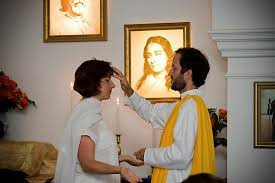
GURU gives DIKSHA by touch of thumb to AJNA CHAKRA
ie,in between the eyebrows or by the touch onto spiritual
hrudaya on the right side of chest.
This has been compared to birds, hen incubating eggs by
directly sitting over them.
2) MANTRA DIKSHA --
GURU whispers bijakshara mantra to the ear of sishya which
is to be kept secret & to be repeated as much as possible.
This can also be done with assistance of spatic japa mala
108 times,1008 times etc.
Mantra = manan (reflection) + antar (in heart); that which is
to be reflected upon in the heart. Alternatively,
mantra = mann (the mind) + tarr (deliver), that which delivers
the mind from samsara.
The smaller the mantra given at the time of Mantra-Diksha,
the more rhythmic its recital and the more convenient and
propitious it is for the aspirant. This leads him fast on the
track of spiritual progress.
Naradji was a Saint who was completely un-attached to
any community or sect. His prime concern was the welfare
of anyone coming in contact with him. Those who have the
welfare of others close to their hearts, are 'Lok Sants'
(Universal Saints). When Naradji initiated the robber, Valia,
the mantra had a longer 'Ra' and a shorter 'ma', and 'ma'
preceded the 'Ra'. Valias, life-force was in the lower
centres of the subtle body. Naradji gave the mantra knowing
fully well that japa of 'maRa' would produce vibrations in
those centers and gradually he would reach the higher
centres without fail. He blessed Valia with Shambhavi-Diksha
as well, thus transmitting his own spiritual energy unto him.
Valia started japa of 'maRa' in right earnest.
Gradually his Kundalini was awakened with the japa
becoming more and more rhythmic, and thus the robber
was transformed into Valmiki Rishi.
3)DRISTI DIKSHA (SHAMBHAVI DIKSHA) --
Diyate Gyan Sadbhavan Shiyate Pashu Bhaavana,
Danshapan Sanyukta Diksha Teneh Keertita.
kinds of animal instincts are demolished, which is granted
by Gurudev in charity is known as Diksha.
Diksha is a unique and rare process of making the life of a
disciple more pure, more enlightened and more successful.
Generally a human being remains under the sway of bad
karmas of past lives which do not allow him to make the
desired level of progress in spite of hard work and sincere
efforts.
Dadabari Ajmer...Origin of Shwetamber Jain Khartargaccha Ideology
Guru Diksha Samaroh – Organized at Shri Sidhdata
The blessing of diksha--a sacred touch during which divine power is initiated
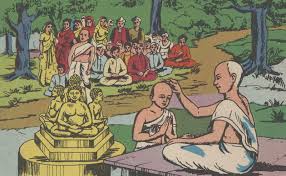
Taking the vow: A 'guru swamy' initiating a youth into Bhavani Deeksha
Guru is giving Diksha to a young sadhu by murmuring a "guru mantra".
A real SELF- REALISED GURU is a JEEVANMUKTA, who
sees GOD(ATHMA) in all. With this thinking he cannot give
DIKSHA, as he cannot think somebody else as SHISHYA
which creates duality or dvaitha. Another reason is that world
what you see is only a mental projection like dream, it is not
real, then where is the question of DIKSHA giving !
A sadhak who is the follower of above guru can think him as
his GURU, but without taking DIKSHA ! Such sadhaks also
make spiritual progress !
RAMANA MAHARSHI is a good example for this type of
GURU. KRIPALUGI MAHARAJ living saint at VRANDAVAN
is another example.You see hundreds of shishyas in TV
programmes but he has told in his speech that he has not
given DIKSHA TO ANYBODY. Avadhootha SADASHIVA
BRAHMENDRA of NERUR,Tamil Nadu also had no
shishyas.
RECEIVING DIKSHA IS NOT SADHAK'S RIGHT ,
IT IS THE JUDGEMENT OF THE GURU THRO' JNANA --
A sadhak may approach a guru & request him for diksha
but GURU by his spiritual vision is able to know everything
about him whether he deserves DIKSHA or not. He may also
test him through other means as follows.
HOW MY GURU ASSESSED ME --
I travelled 250 Kms. from Bangalore to meet him as I heard
he was a holy saint & an Avadootha. I did not request him for
DIKSHA.
My GURU had the capacity to know everything about me,
he came to know the papa I have committed 30
years back. He also tested me as follows --
1) A situation was created naturally to do arathi, as somebody
brought their produce in the farm for his blessings,so GURU
did arathi to GOD's photos along with many swamijies
photos of Sringeri Mutt, then he asked other four people
present including me to do arathi. A spiritually awakened
person's reaction is, tears flowing from eyes, movement of
hands stopping momentarily, mind resting in ATHMA,
awakening of KUNDALINI etc.
2) He asked me to visit a Shiva temple in that road and he sent
one of his disciples to observe me & report back.Similar
reactions as above took place there also. The disciple
reported back what happened there.
3) He called four of his disciples & asked them to recite DEVI
STHOTHRA which also had its reactions on me. Involuntary
movement of hands in the form of MUDRA - ABHAYA
HASTHA took place
4) He entertained all other visitors worldly problems & gave
solutions to them.When I told him I also have worldly
problems he literally turned his back to me. I cannot explain
the reason for it. I knew very well that world is not real
which he has definitely come to know or due to GODDESS
LAKSHMI's GRACE on me. For further spiritual progress,
he advised me not to ask any questions on the last point.
Then he created a situation wherein I had to come out of the
house & stand on the road in front of his house. Then he came
down to the road & gave Sparsha DIKSHA along with Dristi
DIKSHA which was a very very rare thing to happen, as I
have not heard same thing happening to thousands of people
visiting him.
TYPES OF DIKSHA--
1) SPARSHA DIKSHA
2)MANTRA DIKSHA
3)DRISTI DIKSHA (SHAMBHAVI DIKSHA)
4)MANO DIKSHA
1) SPARSHA DIKSHA --
GURU gives DIKSHA by touch of thumb to AJNA CHAKRA
ie,in between the eyebrows or by the touch onto spiritual
hrudaya on the right side of chest.
This has been compared to birds, hen incubating eggs by
directly sitting over them.
2) MANTRA DIKSHA --
GURU whispers bijakshara mantra to the ear of sishya which
is to be kept secret & to be repeated as much as possible.
This can also be done with assistance of spatic japa mala
108 times,1008 times etc.
Mantra = manan (reflection) + antar (in heart); that which is
to be reflected upon in the heart. Alternatively,
mantra = mann (the mind) + tarr (deliver), that which delivers
the mind from samsara.
The smaller the mantra given at the time of Mantra-Diksha,
the more rhythmic its recital and the more convenient and
propitious it is for the aspirant. This leads him fast on the
track of spiritual progress.
Naradji was a Saint who was completely un-attached to
any community or sect. His prime concern was the welfare
of anyone coming in contact with him. Those who have the
welfare of others close to their hearts, are 'Lok Sants'
(Universal Saints). When Naradji initiated the robber, Valia,
the mantra had a longer 'Ra' and a shorter 'ma', and 'ma'
preceded the 'Ra'. Valias, life-force was in the lower
centres of the subtle body. Naradji gave the mantra knowing
fully well that japa of 'maRa' would produce vibrations in
those centers and gradually he would reach the higher
centres without fail. He blessed Valia with Shambhavi-Diksha
as well, thus transmitting his own spiritual energy unto him.
Valia started japa of 'maRa' in right earnest.
Gradually his Kundalini was awakened with the japa
becoming more and more rhythmic, and thus the robber
was transformed into Valmiki Rishi.
3)DRISTI DIKSHA (SHAMBHAVI DIKSHA) --
Guru imparts DIKSHA through a glance as Shukdev
Muni gave to king Parikshit on the fifth day of the seven-day
long narration of the holy Srimad Bhagwat.
This has been compared to fish glancing at the eggs &
blowing air bubbles towards them.
4) MANO DIKSHA --
GURU gives DIKSHA through thought & you will be surprised
to know that this is most powerful as compared to other types.
This has been compared to mother turtle remaining in sea &
thinking about its eggs which it has buried under the sand on
the shore.
GURUS may use a combination of the above types
of DIKHSHA, most common being SPARSHA DIKSHA
& MANTRA DIKSHA.
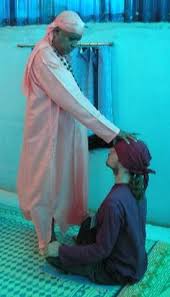
This procedure of transferring the spiritual power is termed as
Shaktipaat. This procedure is not so easy as it appears. A
Guru also acquires spiritual power with tenacious efforts and
then accumulates it inside his body. This procedure of transfer
of spiritual strength can be accomplished only by a Guru,
whose intention is to uplift his disciple in every aspect, to
provide him totality and to give him strength so that the disciple
can emerge successful in his Sadhna and can realise the
authenticity of Mantra and Tantra. The disciple can also
conquer his material obstacles through his divine powers and
in this way can attain fulfillment in his life.
Shaktipaat Diksha is one of the most powerful forms of Diksha.
The Guru through His gaze or by touch of His thumb on the
Third Eye of a disciple activates certain points in this part which
enable the latter to gain much in the area related to that
particular point.There are actually 32 subtle points on the spot
known as the Third Eye on the forehead.16 of these relate to
spiritual accomplishments and 16 to material accomplishments.
Very similarly there are 16 points of each in the Thumb of the
Guru and by matching similar points in His thumb and on the
forehead of the disciple Guru can activate all or some points
and bestow specific benefits on the disciple by making some
of His energy to flow into a specific point or points.
Only the Guru knows well which point has to be pressed in
which way so as to help the disciple gain what he wishes to.
This process is actually nothing but the Guru's method of
transmitting His divine energy through the Third Eye into
specific centre's on the Kundalini of the Sadhak. Every centre
of the Kundalini has special powers and if even one capability
is awakened it can prove enough to make a disciple uniquely
successful in life.
SPECIAL DIKSHAS
Shaktipaat Diksha
Shaktipat Diksha
Shaktipaat. This procedure is not so easy as it appears. A
Guru also acquires spiritual power with tenacious efforts and
then accumulates it inside his body. This procedure of transfer
of spiritual strength can be accomplished only by a Guru,
whose intention is to uplift his disciple in every aspect, to
provide him totality and to give him strength so that the disciple
can emerge successful in his Sadhna and can realise the
authenticity of Mantra and Tantra. The disciple can also
conquer his material obstacles through his divine powers and
in this way can attain fulfillment in his life.
Shaktipaat Diksha is one of the most powerful forms of Diksha.
The Guru through His gaze or by touch of His thumb on the
Third Eye of a disciple activates certain points in this part which
enable the latter to gain much in the area related to that
particular point.There are actually 32 subtle points on the spot
known as the Third Eye on the forehead.16 of these relate to
spiritual accomplishments and 16 to material accomplishments.
Very similarly there are 16 points of each in the Thumb of the
Guru and by matching similar points in His thumb and on the
forehead of the disciple Guru can activate all or some points
and bestow specific benefits on the disciple by making some
of His energy to flow into a specific point or points.
Only the Guru knows well which point has to be pressed in
which way so as to help the disciple gain what he wishes to.
This process is actually nothing but the Guru's method of
transmitting His divine energy through the Third Eye into
specific centre's on the Kundalini of the Sadhak. Every centre
of the Kundalini has special powers and if even one capability
is awakened it can prove enough to make a disciple uniquely
successful in life.
SPECIAL DIKSHAS
Special Diksha means that you can get your desires and
wishes fulfilled through it - like getting rich, famous, popular,
getting a good life partner, good children etc. In short
whatever you wish for can be fulfilled only through special
Diksha. Some 81 types of DIKSHAS have been listed.
There are different kinds of vidyas and each has specific
guru. You want to become a sanyasi then you have to go to
a sanyasa guru, if you need to get initiated to veda you
need to get initiated to gayatri. If you need your kundalini
raised you need a yogic or tantric guru. If you want power of
seeing future knowing the secrets of people you need
yakshni mantra to be initiated. Each power has a different
vidya associated with it and different gurus having siddhi
on the vidya are needed.
whatever you wish for can be fulfilled only through special
Diksha. Some 81 types of DIKSHAS have been listed.
There are different kinds of vidyas and each has specific
guru. You want to become a sanyasi then you have to go to
a sanyasa guru, if you need to get initiated to veda you
need to get initiated to gayatri. If you need your kundalini
raised you need a yogic or tantric guru. If you want power of
seeing future knowing the secrets of people you need
yakshni mantra to be initiated. Each power has a different
vidya associated with it and different gurus having siddhi
on the vidya are needed.
In reality it is only by good fate that a person is able to get
Diksha, and he/she are initiated into a process of coming
close to his Guru by obeying His instructions.
=========================


